


Liberty Under Law: Suffrage and Property Rights
Suggested Teaching Instructions
Introduction:
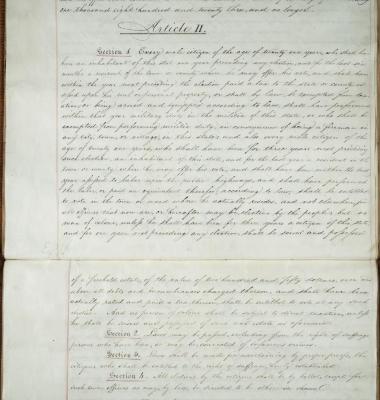
The third New York State Constitution, ratified in 1846, abolished all remnants of feudalism and oligarchical government in the State. It also provided all white men 21 years or older the right to vote whether they owned property or not. For the first time in the constitutional convention process, delegates for the 1846 Constitutional Convention were chosen by New Yorkers for New Yorkers.
Watch Susan B. Anthony's Genius and answer the questions below before analyzing the documents.
Learning Standards:
11.3 EXPANSION, NATIONALISM, AND SECTIONALISM (1800 – 1865): As the nation expanded, growing sectional tensions, especially over slavery, resulted in political and constitutional crises that culminated in the Civil War.(Standards: 1, 3, 4, 5; Themes: TCC, GEO, GOV, ECO, TECH)
11.3b Different perspectives concerning constitutional, political, economic, and social issues contributed to the growth of sectionalism.
Students will examine the emergence of the women’s rights movement out of the abolitionist movement, including the role of the Grimké sisters, Lucretia Mott, and Elizabeth Cady Stanton, and evaluate the demands made at the Seneca Falls Convention (1848).
7.7 REFORM MOVEMENTS: Social, political, and economic inequalities sparked various reform movements and resistance efforts. Influenced by the Second Great Awakening, New York State played a key role in major reform efforts.(Standards: 1, 5; Themes: SOC, CIV, GOV)
7.7c Women joined the movements for abolition and temperance and organized to advocate for women’s property rights, fair wages, education, and political equality.
Students will examine the efforts of women to acquire more rights. These women include Sojourner Truth, Elizabeth Cady Stanton, Matilda Joslyn Gage, and Susan B. Anthony.