


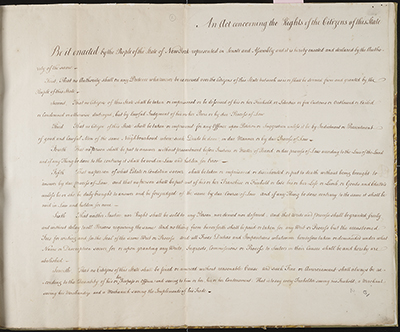
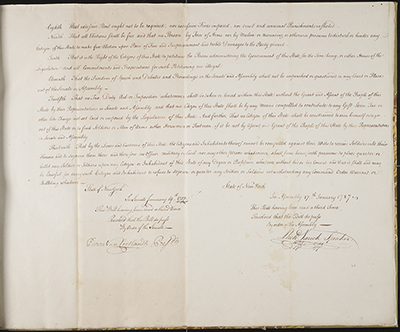
New York Adopts a State Bill of Rights, January 19, 1787
Suggested Teaching Instructions
Learning Standards
7.4 HISTORICAL DEVELOPMENT OF THE CONSTITUTION: The newly independent states faced political and economic struggles under the Articles of Confederation. These challenges resulted in a Constitutional Convention, a debate over ratification, and the eventual adoption of the Bill of Rights.
(Standards: 1, 5; Themes: GOV, CIV)
7.4b The lack of a strong central government under the Articles of Confederation presented numerous challenges. A convention was held to revise the Articles, the result of which was the Constitution. The Constitution established a democratic republic with a stronger central government.
Students will examine the New York State Constitution, its main ideas and provisions, and its influence on the formation of the United States Constitution.
11.2 CONSTITUTIONAL FOUNDATIONS (1763 – 1824): Growing political and economic tensions led the American colonists to declare their independence from Great Britain. Once independent, the new nation confronted the challenge of creating a stable federal republic.
(Standards: 1, 5; Themes: TCC, GOV, CIV, ECO)
11.2c Weaknesses of the Articles of Confederation led to a convention whose purpose was to revise the Articles of Confederation but instead resulted in the writing of a new Constitution. The ratification debate over the proposed Constitution led the Federalists to agree to add a bill of rights to the Constitution.
Students will examine the rights and protections provided by the Bill of Rights and to whom they initially applied.
Introduction
The first State Constitution, adopted in 1777, left some issues unaddressed. These had to be remedied in the next few years.
The document guaranteed freedom of religion but not other rights.
This omission was addressed by legislation a decade later, which guaranteed protection of free speech and press, trial by jury, the right to petition the government, due process of law, taxes could be levied only with the people’s consent, and other freedoms.
The original Bill of Rights was later expanded, included in subsequent revisions of the state constitution, and is the predecessor of the Bill of Rights in the state constitution today.
This learning activity is a part of the larger resource, Teaching Revolutionary New York with Historical Documents.