Skip to content
Teaching the Holocaust and other Genocides

Rudy Appel: Education of Jews

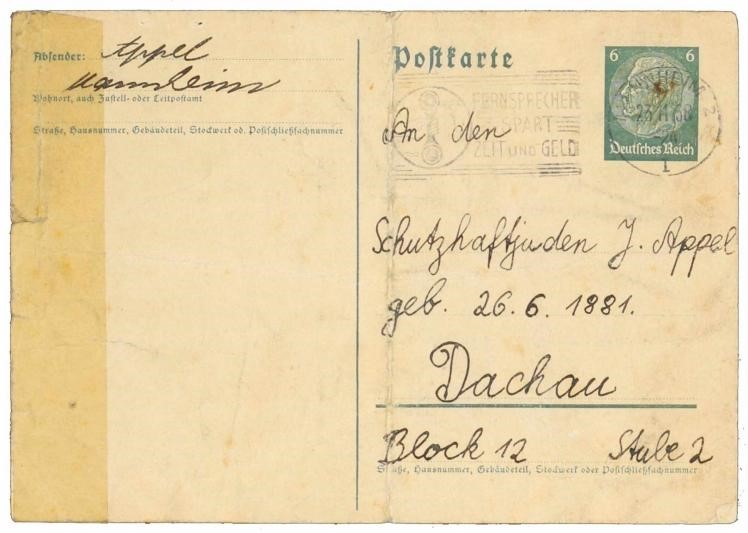
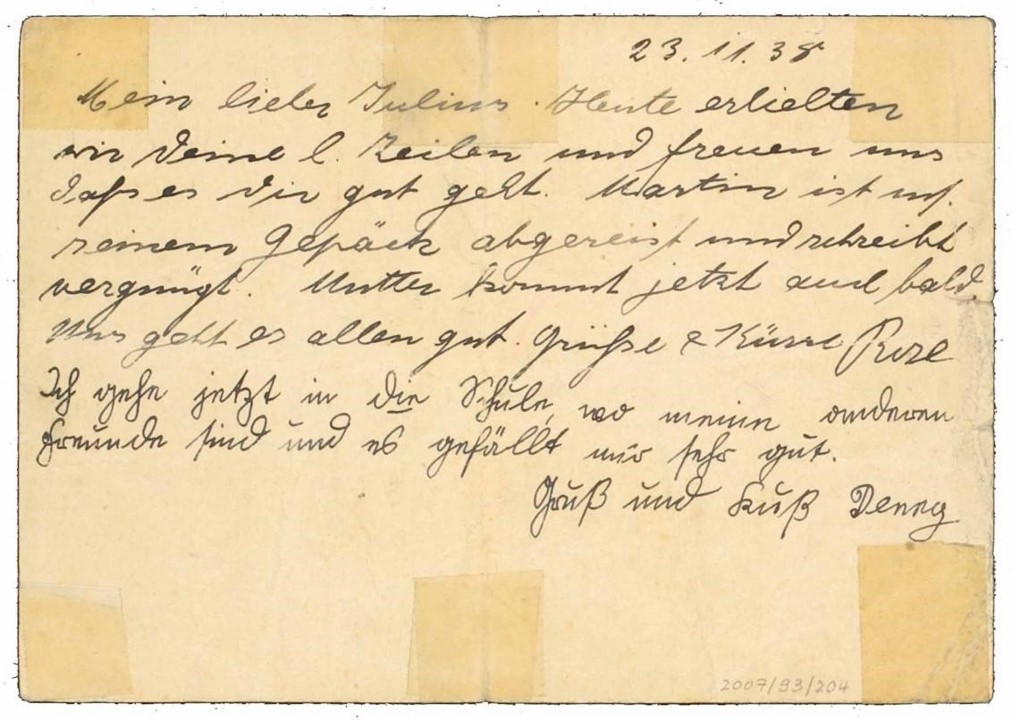
This seemingly innocuous postcard from November 23, 1938, bearing a six-penny-stamp issued by the Third Reich, which shows an image of the deceased President Paul von Hindenberg, was written by Rosa and Rudolf Appel (Denny) to Julius Appel at Dachau Concentration Camp. The child’s handwriting belongs to thirteen-year-old Rudolf, who writes to his father Julius: “I am going to school now, where my other friends all are, and I like it a lot.” The text appears very straightforward; if one examines the context in which the postcard was written more closely, however, its poignancy becomes evident.  For “Denny” is writing on November 23, 1938 to the “Jew in Protective Custody Julius Appel,” one of 30,000 Jewish men deported and imprisoned in Nazi concentration camps (in this case, Dachau near Munich)  following the November 9-10  pogroms, or Kristallnacht.   

Rudolf had started school during the Weimar Republic. Following primary school, he attended the Karl-Friedrich Gymnasium in Mannheim. Why did he have to leave that school so suddenly in November 1938? And why was it so important for him to mention that all his friends were in the new school? Following their seizure of power in January 1933 the Nazis, in their restructuring of the educational system, slowly removed Jewish students from the public schools.

 Postcard from Rosa und Rudolf (here signing Denny) Appel to Julius Appel, Mannheim,
November 23, 1938

The measures to affect this were introduced via the “Statute to combat the overcrowding of German Schools and Universities” enacted on April 25, 1933. Under this law, the number of children of “non-Aryan” descent who could attend a school was capped at 5 percent.  This new regulation was implemented at about the same time as the “Statute for the Regeneration of the Civil Service,” which excluded Jews from civil service positions, including teachers.  At first, primary schools were excluded from the scope of the law. Moreover, the children of Jewish World War I veterans could generally attend all public schools, even if the quota of “non-Aryan” children was exceeded. 

The exclusion of Jewish teachers and students from the public schools increased the demand for Jewish schools dramatically. Soon, the existing Jewish schools were filled to capacity, and many new educational institutions had to be established. These schools essentially had three goals: (1) to provide children with a space in which they would be protected from antisemitic attacks; (2) to cultivate a positive Jewish self-image through intensive study of Jewish history and culture; (3) especially starting in 1938, to be prepared for emigration and a life outside Germany (which meant foreign language instruction). The Chairman of the Jewish Community of Mannheim, Max Grünewald, summarized the school’s mission in 1936 as follows: "We hope that the school will provide calm and continuity to many parents, as well. They may now rest assured that their children can experience childhood and youth with unbroken spirits, within their own world and in the steady and festive rhythm of the Jewish year, but also that they will be acquiring at the same time the indispensable tools for their future."2 In this way, many schools were able to develop into "islands of security" for children and young adults. 

The situation worsened after Kristallnacht, when on November 15, 1938, the Nazi Ministry for Science and Education issued an order stating that "[a]fter the nefarious murder of Paris … it is unacceptable to expect that any German teacher provide instruction to Jewish schoolchildren. It should also be self-evident that it is intolerable for German schoolchildren to sit in a classroom shared with Jews." To be sure, the order continued, "the segregation of the races in the school system has already been affected to a large extent over the past several years ... nevertheless, there remains an oddment of Jewish children in German schools, who henceforth can no longer be permitted to attend school together with German boys and girls.”3  Thus, this law forced Rudolf Appel to leave the Gymnasium he was attending and switch to the Jewish School in Mannheim. 

But, Rudolf did not stay in Mannheim.  Prior to the November pogroms, the Appel family had attempted to emigrate, as Julius Appel was no longer permitted to work as a notary under the 1933 Statute for the Regeneration of the Civil Service. In late November, Rudolf’s sixteen-year-old brother Martin emigrated to New York via the Netherlands to live with Julius’ brother. After being released from Dachau, Julius also left Germany in January 1939. 

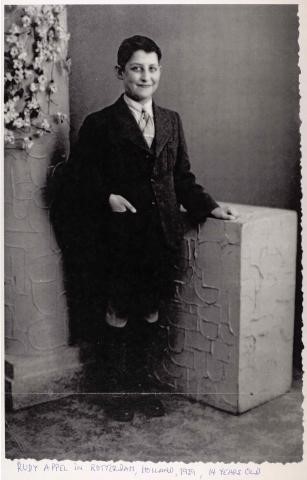
Rudolf

Rudolf Appel at age 14,
Rotterdam, 1939

Discussion Questions 

  1. What was the significance of the postcard written by thirteen-year-old Rudolf (Denny) to his father Julius Appel at Dachau Concentration Camp, and how does its seemingly innocent content reveal a deeper historical context? 

  2. How did the educational policies introduced by the Nazi regime impact Jewish children like Rudolf Appel, and what adjustments did Jewish communities make to continue their education? 

  3. What challenges did the Appel family face in their attempts to emigrate from Nazi Germany, and how did the events of Kristallnacht and subsequent policies affect their situation? 

  4. How did Rudolf Appel’s journey through various European countries during World War II illustrate the broader experiences of Jewish refugees, and what role did the village of Le Chambon sur Lignon play in his survival? 

  5. What does the story of Rudy Appel and his family tell us about resilience, displacement, and survival during the Holocaust, and how did Rudy’s life change after his immigration to the United States? 

Sources

Jüdisches Museum Berlin
https://www.jmberlin.de/en/exclusion-of-jewish-children-from-public-schools-1938

United States Holocaust Memorial Museum https://collections.ushmm.org/search/catalog/irn608011?rsc=265719&cv=0&x=465&y=1495&z=2.6e-4