Skip to content
Teaching the Holocaust and other Genocides

Rosenstraße Protest Memorials

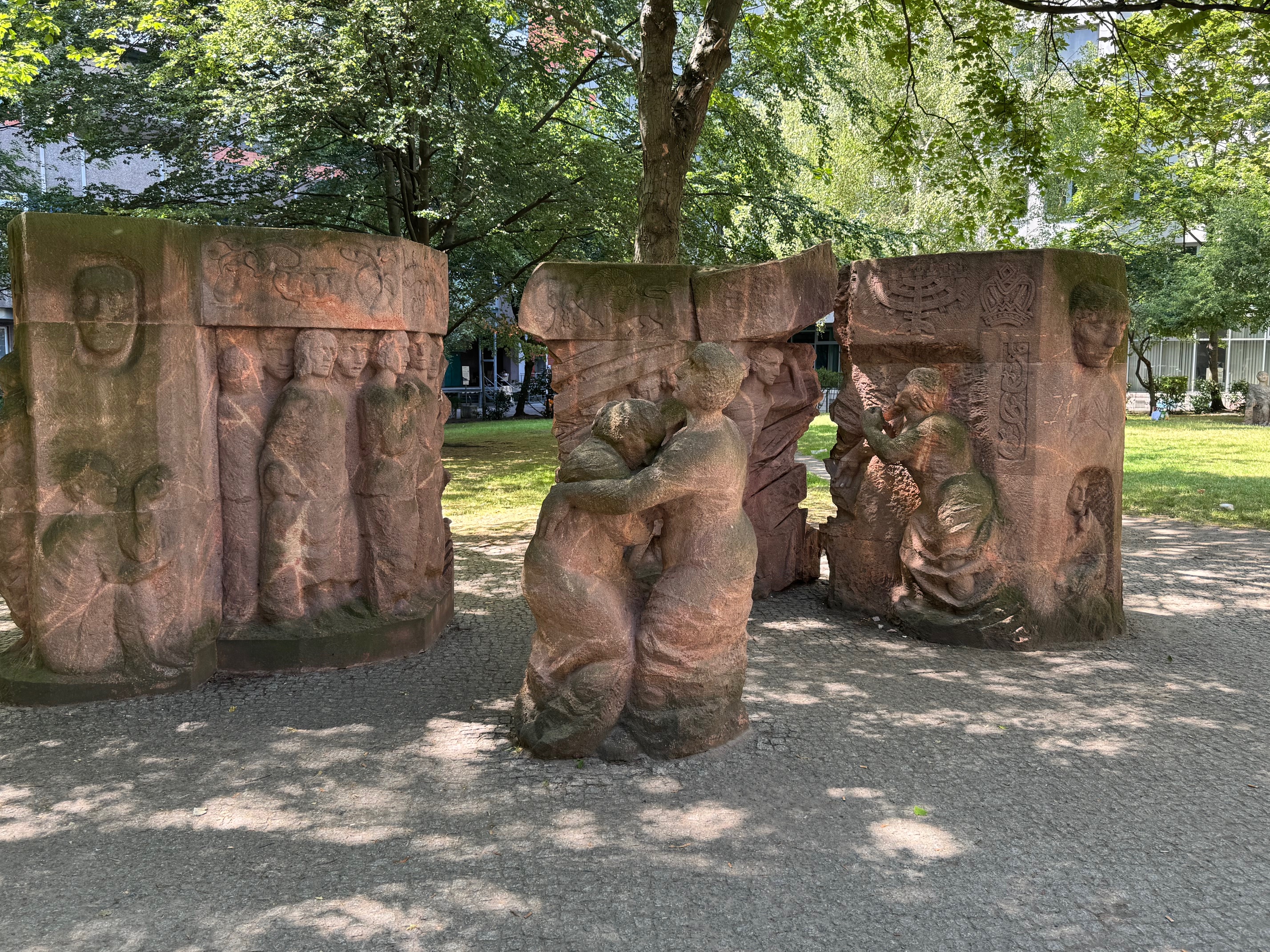
Just after the German defeat in the Battle of Stalingrad in 1943, Gestapo  arrested around 1,800 Jewish men, almost all of them married to non-Jewish and housed temporarily at Rosenstraße 2–4, a welfare office for the Jewish community located in Central Berlin. Before these men could be loaded onto the trains to be deported, their wives and other close relatives turned up on the street near the building. For a week, the protesters, mainly women, demanded their husbands back by holding a peaceful protest. The protesters appeared first in ones and twos; afterwards their number grew rapidly, and perhaps a total of 6000 participated at one time or another. Not wanting to invite open dissent by shooting the women down in the streets, Goebbels, at that time Gauleiter of Berlin, released the incarcerated individuals, and ordered the return of 25 men already sent to Auschwitz. Almost all the released men survived the war.  The building on Rosenstraße , in which the men were held was destroyed during an Allied bombing of Berlin at the end of the war. The original Rosenstraße location is now marked by a rose colored Litfaß column 2–3 meters high, dedicated to the demonstration. Information about this event is posted on the Litfaß column. In the mid-1980s, Ingeborg Hunzinger, an East German sculptor, created a memorial to those women who took part in the Rosenstraße Protest. The memorial, named "Block der Frauen" (Block of Women), was erected in 1995 in a park not far from the site of the protest. The sculpture shows protesting and mourning women, and an inscription on the back reads: "The strength of civil disobedience, the vigor of love overcomes the violence of dictatorship; Give us our men back; Women were standing here, defeating death; Jewish “Block der Frauen,"  

Rosenstrasse Memorial


Rosenstrasse Memorial


Rosenstrasse Memorial


Rosenstrasse Protest Memorial

Discussion Question

What do the expressions and body language of the figures in the Rosenstraße sculptures convey about the emotions and experiences of the women who protested?

Sources

Faces of the Holocaust: The Upstander • Unpacked for Educators. (n.d.). Unpacked for Educators. https://unpacked.education/video/faces-of-the-holocaust-the-upstander/

Friedländer, S. & Mazal Holocaust Collection. (1993). Memory, history, and the extermination of the Jews of Europe. Indiana University Press.

Kaplan, M. A. (1999). Between Dignity and Despair: Jewish Life in Nazi Germany. Oxford University Press.

The Rosenstraße Demonstration, 1943. (2025). Holocaust Encyclopedia. https://encyclopedia.ushmm.org/content/en/article/the-Rosenstra%C3%9Fe-demonstration-1943

Stoltzfus, N. (2001). Resistance of the heart intermarriage and the Rosenstrasse protest in Nazi Germany. New Brunswick, Nj London Rutgers Univ. Press.