Skip to content
Teaching the Holocaust and other Genocides

Robert H. Jackson

Historical Context

It is the Summer of 1945, representatives from the United States, the United Kingdom, the Soviet Union, and France meet to discuss how to hold the surviving leaders of Nazi Germany responsible for the acts they committed during the Holocaust. They formed the International Military Tribunal, and on November 20, 1945, the Nuremberg trials began.  

All defendants pleaded not guilty, but the prosecutors, particularly Justice Robert H. Jackson, were determined to present overwhelming evidence of Nazi crimes to prove the defendants’ irrefutable guilt and lead to their conviction. Jackson also emphasized establishing individual responsibility and providing a history lesson to the defeated Germans. Over the course of more than 15 months, Jackson’s work ultimately helped lead to the conviction of all but three defendants. 

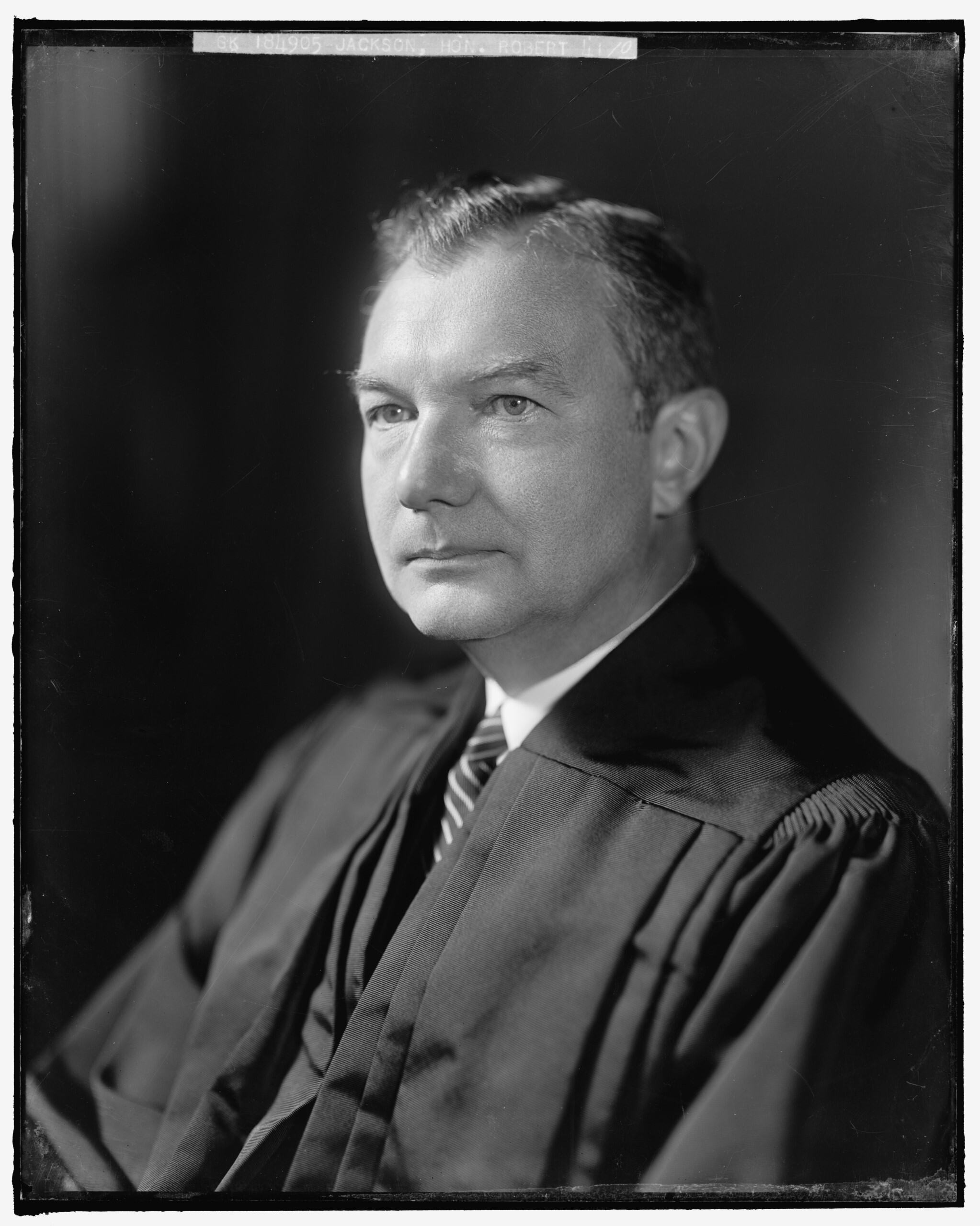
Jackson Supreme Court Portrait

Early Life and Background

Robert H. Jackson was born in 1892 in Pennsylvania and raised in the hamlet of Frewsburg, New York, about five miles from the Pennsylvania border. After graduating from high school, Jackson decided on a career in law. At the time, attending college or law school was not required, the “law student” received training from a successful, practicing lawyer. Still, Jackson was eager to obtain a law certificate. He studied and worked at a law firm in Jamestown, New York. His training there allowed him to skip the first year of a two-year law program at Albany Law School, where he ultimately earned his law certificate in 1913 at 21 years old. Jackson then spent twenty years practicing law in western New York State; he became an accomplished trial and appellate lawyer, a city lawyer, a corporate lawyer and counselor, a member of the American Law Institute, and the national chairman of the American Bar Association’s Conference of Bar Association Delegates.                                   

Outside of law, Jackson maintained an active interest and involvement in Democratic Party politics at the local, state, and national level. As a teenager, he met Franklin Delano Roosevelt, who was then a young state senator. Roosevelt, who eventually went on to become the governor of New York and president of the United States, never forgot about Jackson. In 1934, President Roosevelt appointed Jackson as Counsel of the Bureau of Internal Revenue in the Treasury Department. Two years later, Jackson was elevated to the Department of Justice where he served as Assistant Attorney General heading the Tax Division. Between 1936 and 1941, Jackson was appointed to a multitude of positions—each more prominent than the last—including Assistant Attorney General, Solicitor General, and Attorney General. Roosevelt then nominated and the Senate confirmed him as a Justice of the Supreme Court of the United States.  

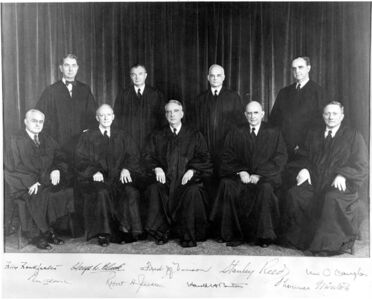
U.S. Supreme Court Justices ca. 1950 with Jackson in the back row, second from the left 

It has been said that Roosevelt favored Jackson so highly that he hoped for Jackson to eventually succeed him as president. Roosevelt’s successor, Harry Truman, also thought very highly of Jackson, which led him to appoint Jackson as U.S. Chief of Counsel for the prosecution of Nazi war criminals. Jackson helped draft the charter for the International Military Tribunal, the document that defined the laws and procedures for the Nuremberg trials. 

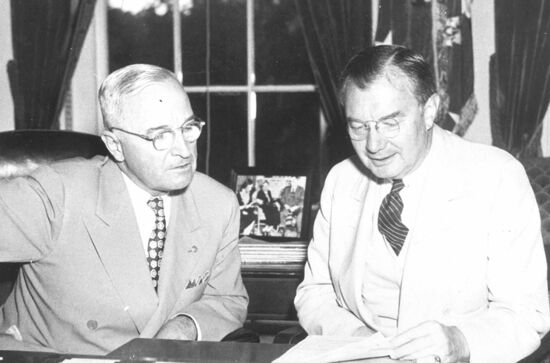
President Truman and Jackson,
September 1945  

When Truman appointed Jackson as the chief prosecutor at Nuremberg, he took a leave of absence from the Supreme Court to dedicate his full attention to his new assignment. Although he repeatedly offered to resign from the Supreme Court entirely, President Truman declined this request every time.  

Truman knew that Jackson had the skills and knowledge necessary to be successful at Nuremberg. Historian Kim Christian Priemel described Jackson as "a versatile politician and a remarkable orator, if not a great legal thinker.” But on top of all that, Jackson eagerly wanted the position and pursued it, despite knowing that there was a chance that he could fail and that the workload would be highly intense and complex. 

Role at the Nuremberg Trials

When Jackson accepted the appointment as Chief Prosecutor, his understanding was that he would be prosecuting war criminals based on overwhelming evidence and that verdicts would be quickly reached. He learned very early on, however, that almost no evidence had been collected and that an agreement had not yet been made with the Allies of how to proceed with the trial. These tasks largely became his responsibility.  

In establishing the framework of how to prosecute Nazi war criminals, Jackson had three goals: 

  1. Preventing a resurgence of Nazism in Germany by showing that the concept of planning and carrying out actions of war were criminal acts. 

  1. Bringing charges against the various organizations within the Nazi government so that if guilty verdicts were determined, each organization could be prosecuted further in future trials.  

  1. Prosecuting Nazi leaders not simply based on testimonies, but rather, by using the highly detailed, meticulously organized, and utterly massive collection of Nazi records (the prosecution team examined more than 100,000 German documents and entered 4,600 into evidence).  

This framework was established over the summer of 1945 and in August, Jackson and the Allies officially signed the charter.  

On November 21st, 1945, Jackson delivered his opening statement, emphasizing the criminal conspiracy behind the Nazi government. Here are some excerpts:  

The privilege of opening the first trial in history for crimes against the peace of the world imposes a grave responsibility. The wrongs which we seek to condemn and punish have been so calculated, so malignant, and so devastating, that civilization cannot tolerate their being ignored, because it cannot survive their being repeated. That four great nations, flushed with victory and stung with injury stay the hand of vengeance and voluntarily submit their captive enemies to the judgment of the law is one of the most significant tributes that Power has ever paid to Reason. This Tribunal, while it is novel and experimental, is not the product of abstract speculations nor is it created to vindicate legalistic theories. This inquest represents the practical effort of four of the most mighty of nations, with the support of 17 more, to utilize international law… 

There is no count in the Indictment that cannot be proved by books and records. The Germans were always meticulous record keepers, and these defendants had their share of the Teutonic passion for thoroughness in putting things on paper. Nor were they without vanity. They arranged frequently to be photographed in action. We will show you their own films. You will see their own conduct and hear their own voices as these defendants re-enact for you, from the screen, some of the events in the course of the conspiracy. We would also make clear that we have no purpose to incriminate the whole German people… 

I will now take up the subject of “Crimes in the Conduct of War”. Even the most warlike of peoples have recognized in the name of humanity some limitations on the savagery of warfare. Rules to that end have been embodied in international conventions to which Germany became a party. This code had prescribed certain restraints as to the treatment of belligerents. The enemy was entitled to surrender and to receive quarter and good treatment as a prisoner of war. We will show by German documents that these rights were denied, that prisoners of war were given brutal treatment and often murdered. This was particularly true in the case of captured airmen, often my countrymen… 

They [the accused] led their people on a mad gamble for domination. They diverted social energies and resources to the creation of what they thought to be an invincible war machine. They overran their neighbors. To sustain the “master race” in its war-making, they enslaved millions of human beings and brought them into Germany, where these hapless creatures now wander as “displaced persons”. At length bestiality and bad faith reached such excess that they aroused the sleeping strength of imperiled Civilization. Its united efforts have ground the German war machine to fragments. But the struggle has left Europe a liberated yet prostrate land where a demoralized society struggles to survive. These are the fruits of the sinister forces that sit with these defendants in the prisoners’ dock. 

In justice to the nations and the men associated in this prosecution, I must remind you of certain difficulties which may leave their mark on this case. Never before in legal history has an effort been made to bring within the scope of a single litigation the developments of a decade, covering a whole continent, and involving a score of nations, countless individuals, and innumerable events. Despite the magnitude of the task, the world has demanded immediate action. This demand has had to be met, though perhaps at the cost of finished craftsmanship. To my country, established courts, following familiar procedures, applying well-thumbed precedents, and dealing with the legal consequences of local and limited events seldom commence a trial within a year of the event in litigation. Yet less than 8 months ago today the courtroom in which you sit was an enemy fortress in the hands of German SS troops. Less than 8 months ago nearly all our witnesses and documents were in enemy hands. The law had not been codified, no procedures had been established, no tribunal was in existence, no usable courthouse stood here, none of the hundreds of tons of official German documents had been examined, no prosecuting staff had been assembled, nearly all of the present defendants were at large, and the four prosecuting powers had not yet joined in common cause to try them. I should be the last to deny that the case may well suffer from incomplete researches and quite likely will not be the example of professional work which any of the prosecuting nations would normally wish to sponsor. It is, however, a completely adequate case to the judgment we shall ask you to render, and its full development we shall be obliged to leave to historians. 

Before I discuss particulars of evidence, some general considerations which may affect the credit of this trial in the eyes of the world should be candidly faced. There is a dramatic disparity between the circumstances of the accusers and of the accused that might discredit our work if we should falter, in even minor matters, in being fair and temperate… 

Jackson’s speech impressed his allied colleagues, the tribunal, the audience, and even the defendants and their counsel. Following his opening statement, Jackson moved forward with proving the Nazi conspiracy leading up to World War II, as described above in goal #1.  

Over the course of the trial, Jackson went on to cross examine various defendants and witnesses, including Reichstag president Hermann Goering who, under Jackson’s questioning, admitted to the accuracy and legitimacy of crucial documentary evidence. Jackson delivered his closing argument on July 26th, 1946, reiterating that a guilty verdict should be reached for each defendant based on the overwhelming evidence. Nonetheless, he did not advocate for any particular punishments for the defendants.  

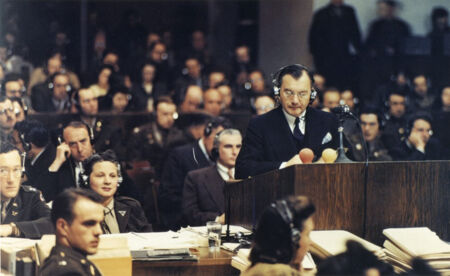
Jackson Delivering the Opening Statement at Nuremberg

Relevance and Memory

Jackson assumed his role in the Nuremberg Trials with the intention of proving that due process and fairness could successfully be used to prosecute and convict a group of defendants who many believed did not require a trial to establish guilt. In accumulating the evidence that was used in the trial, Jackson’s work led to an historical record containing millions of pages of supporting documents in addition to the 42-volume trial transcript. In the years following the trials, these materials have repeatedly been used to combat incidents of Holocaust denial. In the years leading up to his death in 1954 at age 62, Jackson described his work at Nuremberg as the most important of his life.  

Jackson is buried in Frewsburg, New York. In 2001, the Robert H. Jackson Center was established in Jamestown and now serves as the home of exhibits on Jackson's life, collections of his writings, and photos from the International Military Tribunal. Further judicial papers from Jackson’s career are housed in the Library of Congress. Furthermore, the United States federal courthouse in Buffalo, New York is named in honor of Jackson. 

Discussion Questions 

1. While at Nuremberg, Jackson offered to resign from the Supreme Court to allow another justice to serve in his place, but Truman repeatedly rejected this offer, keeping the seat open for Jackson until his return. Why do you think Truman was so insistent on keeping the position open for Jackson? To what extent do you agree with Truman’s decision?  

2. Jackson was determined to continue with his involvement in the Nuremberg Trials, especially after he found out how difficult the task would be. What do you think this says about Jackson’s character and morals? 

3. Which of Jackson’s three goals do you think was the most important? Explain.  

4. Which phrase or excerpt from Jackson’s opening statement stands out to you? Why?   

5. Why do you think Jackson chose not to advocate for specific punishments for the defendants but instead left these up to the Court?  

6. Leading up to the Nuremberg Trials, it was said by many that the trials would not be necessary due to the “obvious guilt” of the defendants. However, despite the substantial time and resources necessary, especially on his own part, Jackson continuously emphasized the importance of holding trials and fully prosecuting every defendant using as much evidence as possible. Why do you think he was so adamant about this, and what is your perspective on his ideals? 

Sources

Barrett, J. Q. (2025). The Nuremberg Roles of Justice Robert H. Jackson. Washington University Open Scholarship. https://openscholarship.wustl.edu/law_globalstudies/vol6/iss3/5
Similarly to his chapter in the Reginbogin book, Barrett’s essay provides an overview of Jackson’s life and work but with a marginally heavier focus on his career prior to serving on the Supreme Court. With regards to his analysis of Jackson’s work at Nuremberg, this essay appears to provide a slightly less objective approach to Jackson by aiming to further highlight Jackson’s successful performance during the trial. A notable example of this is the more abbreviated analysis of Jackson’s cross examination of Hermann Goering compared to the longer version in the Reginbogin piece that addresses the moments in which Jackson appeared to struggle. Various components of this essay are featured throughout this case study.   

Cross Examination of Goering V - Robert H Jackson Center. (2014). Robert H Jackson Center. https://www.roberthjackson.org/nuremberg-event/cross-examination-of-goering-v/
Ten-minute video containing various clips from Jackson’s cross examination of Goering.  

JACKSON, ROBERT. HONORABLE. (n.d.). Library of Congress, Washington, D.C. 20540 USA. https://www.loc.gov/item/2016862701/
Portrait of Robert Jackson.  

Jackson, R. (1945, November 21). Opening Statement before the International Military Tribunal - Robert H Jackson Center. Roberthjackson.org. https://www.roberthjackson.org/speech-and-writing/opening-statement-before-the-international-military-tribunal/ 
Jackson’s opening statement at Nuremberg.  

Kim Christian Priemel. (2018). The Betrayal. Oxford University Press.
Referred to as the “first comprehensive study of the Nuremberg trials,” Priemel’s book dissects the topic by providing a thorough context of the events and figures involved in the planning of Nuremberg before carefully outlining every stage of the trial from start to finish. Numerous key figures are highlighted, Jackson, of course, being one of them. Jackson is mentioned in multiple chapters, most notably chapters three and four. Elements from these chapters are featured throughout this case study.  

National Archives NextGen Catalog. (2024). Archives.gov. https://catalog.archives.gov/id/348264169  
Supreme Court Justices photo.  

The National WWII Museum. (2020, November 20). “The Grave Responsibility of Justice”: Justice Robert H. Jackson’s Opening Statement at Nuremberg. The National WWII Museum | New Orleans. https://www.nationalww2museum.org/war/articles/robert-jackson-opening-statement-nuremberg  
Photo of Jackson delivering his opening statement at Nuremberg. Photo credit reads: Courtesy of the US Army Signal Corps. Katherine Fite Lincoln Papers, Harry S. Truman Library & Museum. 

Reginbogin, H. R., Safferling, M., Hippel, W. R., & Proquest (Firm. (2006). The Nuremberg Trials : international criminal law since 1945 : 60th anniversary international conference. K.G. Saur. https://www.google.com/books/edition/The_Nuremberg_Trials_International_Crimi/5h_8dxXEIPsC?hl=en&gbpv=0  
This book contains a series of essays, each of which focuses on a historical and/or legal perspective of the individuals involved in the Nuremberg Trials. Law Professor John Q. Barrett wrote a chapter dedicated entirely to Jackson, in which Barrett summarizes Jackson’s legal training and career leading up to the Nuremberg Trials. Barrett describes Jackson’s relationships with Roosevelt and Truman before outlining the manner in which Jackson approached and prepared for Nuremberg. Jackson’s performance at Nuremberg is highlighted with special emphasis on his opening statement and examination of Hermann Goering. Various components of the chapter, which spans from page 129 to 137 of the book, are included throughout this case study.

The Report to the President - Robert H Jackson Center. (2015, December 7). Robert H Jackson Center. https://www.roberthjackson.org/nuremberg-event/the-report-to-the-president/
Photo of President Harry Truman with Robert Jackson. Photo credit reads: Harry S. Truman Library and Museum.

RobertHJacksonCenter. (2008). Nuremberg Day 2 Justice Robert H. Jackson’s Opening Statement, Nuremberg, November 21, 1945 [YouTube Video]. In YouTube. https://www.youtube.com/watch?v=L50OZSeDXeA
Excerpts from Jackson’s opening statement at Nuremberg.  

Robert H. Jackson Center. (n.d.). Nuremberg Timeline - Robert H Jackson Center. Www.roberthjackson.org. https://www.roberthjackson.org/nuremberg-timeline/​​​​​​​ 
The Robert H. Jackson Center website contains numerous highly detailed pages that allow for an exceptionally thorough dive into Jackson’s work pertaining to the Nuremberg Trials, as well as his work outside of Nuremberg. The link above is a key example, as it contains a detailed textual and photographic timeline embedded with several video clips from throughout the events of the trial.