About Benjamin Ferencz. (n.d.). Www.ushmm.org. https://www.ushmm.org/genocide-prevention/simon-skjodt-center/work/ferencz-international-justice-initiative/benjamin-ferencz
A general, concise overview of Ferencz’s life and career with emphasis on his involvement at Nuremberg. This source also provides links to additional materials of varying formats.
Barrett, J. Q. (2025). The Nuremberg Roles of Justice Robert H. Jackson. Washington University Open Scholarship. https://openscholarship.wustl.edu/law_globalstudies/vol6/iss3/5
Similarly to his chapter in the Reginbogin book, Barrett’s essay provides an overview of Jackson’s life and work but with a marginally heavier focus on his career prior to serving on the Supreme Court. With regards to his analysis of Jackson’s work at Nuremberg, this essay appears to provide a slightly less objective approach to Jackson by aiming to further highlight Jackson’s successful performance during the trial. A notable example of this is the more abbreviated analysis of Jackson’s cross examination of Hermann Goering compared to the longer version in the Reginbogin piece that addresses the moments in which Jackson appeared to struggle. Various components of this essay are featured throughout this case study.
Ben Ferencz, the last living Nuremberg prosecutor, has died at age 103 | 60 Minutes. (n.d.). Www.youtube.com. https://www.youtube.com/watch?v=R-uxyrHJ_mE
60 Minutes segment on Ferencz recorded in 2017 and broadcast in 2023 after his death. Lesley Stahl’s narration drives the video which covers Ferencz’s childhood, military service, involvement at Nuremberg, and work during his later years.
Ben Ferencz recalls his work on the Einsatzgruppen Trial. (2021, December 28). Judicature.duke.edu. https://judicature.duke.edu/articles/last-living-nuremberg-trial-prosecutor-recalls-his-work-on-the-einsatzgruppen-trial/
Transcript of a conversation between Ben Ferencz and Michael P. Scharf, co-dean of Case Western Reserve Law School. Ferencz discusses elements of his early life, education, legal training, as well as his work at and beyond Nuremberg. The conversation features a mix of distinguished quotes from Ferencz and teachings tied to his experience.
Earl, H. (2009). The Nuremberg SS-Einsatzgruppen Trial, 1945-1958.
A thorough and comprehensive overview of the proceedings of the Einsatzgruppen trial with special emphasis on the key figures involved and the roles they played. In addition to the book’s intended focus, Earl provides substantial context behind the origin of the subsequent Nuremberg trials, making the work extremely user friendly for readers going in without a complete understanding of the International Military Tribunal. This is perhaps the only book that is fully dedicated to highlighting the importance of the Einsatzgruppen trial without completely isolating it from the rest of the Nuremberg trials. As such, Ferencz’s background and involvement in the trial are featured prominently throughout the book, making it the longest secondary source utilized in the development of this case study.
Ferencz Opening Statement at Nuremburg. (2019, October 28). Benjamin B. Ferencz. https://benferencz.org/articles/pre-1970/ferencz-opening-statement-at-nuremburg/
Excerpts from Ferencz’s opening statement at Nuremberg.
McFadden, R. D. (2023, April 8). Benjamin B. Ferencz, Last Surviving Nuremberg Prosecutor, Dies at 103. The New York Times. https://www.nytimes.com/2023/04/08/world/europe/benjamin-b-ferencz-dead.html
Obituary of Ferencz which outlines his life and career. In addition to providing additional information surrounding Ferencz’s work after Nuremberg, this article provides context pertaining to his wife and children that are not necessarily present in other sources. Other unique pieces of information range from Ferencz’s ability to speak six languages to his authoring of nine books.
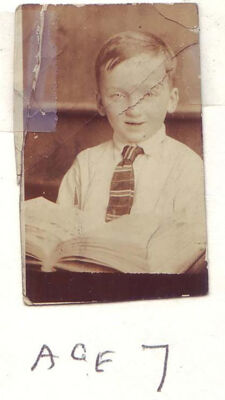
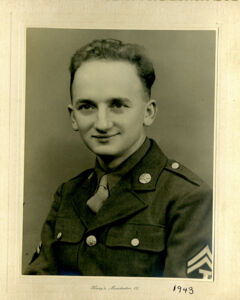
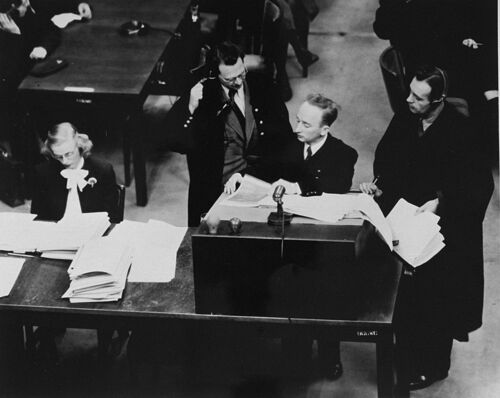
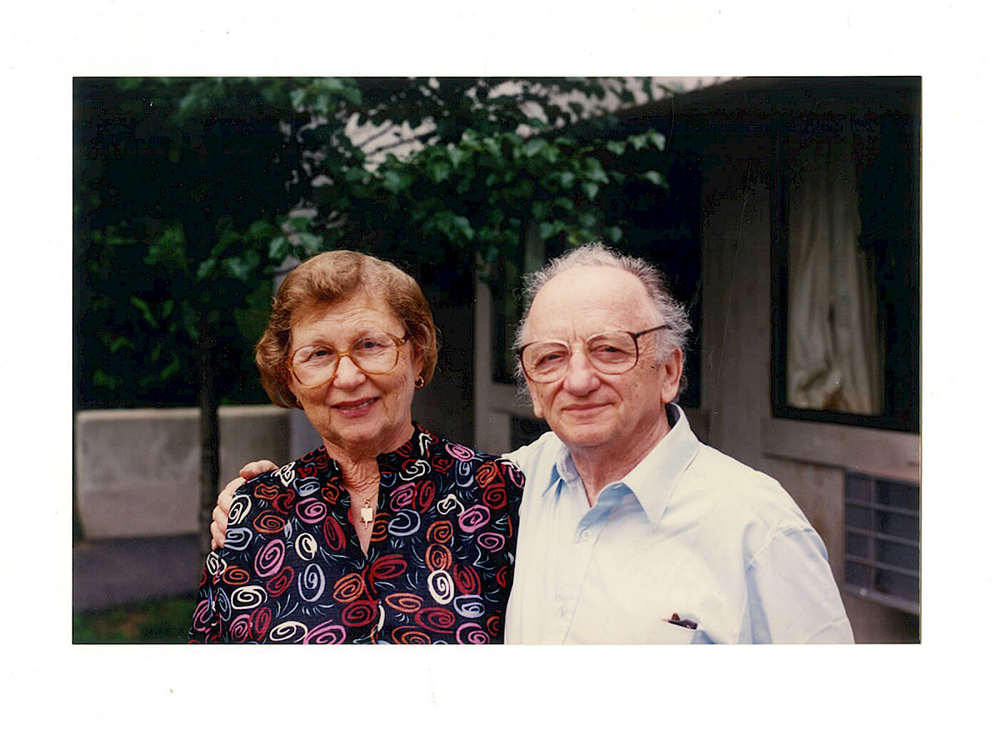
Photos - Benjamin B. Ferencz. (2023, April 14). Benjamin B. Ferencz. https://benferencz.org/gallery/
Collection of photos from various points in Ferencz’s life. Photos are categorized primarily by decade with sections dedicated to his time in the army, as well as at Nuremberg. All but two photos included in this case study are a part of this photo collection. The website also contains numerous other materials, including writings, videos, and audio clips pertaining to Ferencz’s life, work, and accomplishments.
Reginbogin, H. R., Safferling, M., Hippel, W. R., & Proquest (Firm. (2006). The Nuremberg Trials : international criminal law since 1945 : 60th anniversary international conference. K.G. Saur. https://www.google.com/books/edition/The_Nuremberg_Trials_International_Crimi/5h_8dxXEIPsC?hl=en&gbpv=0
This book contains a series of essays, each of which focuses on a historical and/or legal perspective of the individuals involved in the Nuremberg Trials. A transcript of a talk or lecture given by Ben Ferencz is found on pages 153 to 162. Within the first few sentences, Ferencz acknowledges that he is giving this talk with “no prepared text,” but that he intends to share his personal experiences regarding his involvement in the Einsatzgruppen trial in a period of approximately 20-30 minutes. The work appears to be unedited in the sense that Ferencz’s words come across in the manner in which he speaks. Regardless, this only helps to provide the reader with the sensation that Ferencz is talking to them directly. Much like other talks, this one provides an overview of Ferencz’s experiences and observations surrounding Nuremberg. What makes this work stand out is the level of detail he provides regarding the contents of the evidence he uncovered leading up to the Einsatzgruppen trial, as well as the variety of statistics unearthed by his investigative team and conversations he had with Telford Taylor. Ferencz concludes with a Q and A session with members of the audience who were present during his talk. Although the specific date in which the talk took place is not provided, Ferencz quips that his ears are “over 170 years old, combined.”
RobertHJacksonCenter. (2018, May 7). Ben Ferencz Nuremberg Einsatzgruppen Case #9 Opening. YouTube. https://www.youtube.com/watch?v=b67B-MoKG_o
Excerpts from Ferencz’s opening statement at Nuremberg.
Taylor, T. (2025). Opening Statement for the United States of America. Digital Commons @ University of Georgia School of Law. https://digitalcommons.law.uga.edu/nmt9/2/
Scan of type-written document containing the full opening statement delivered by Benjamin B. Ferencz at Nuremberg.
United States Holocaust Memorial Museum. (n.d.). Subsequent Nuremberg Proceedings, Case #9, The Einsatzgruppen Case. Encyclopedia.ushmm.org. https://encyclopedia.ushmm.org/content/en/article/subsequent-nuremberg-proceedings-case-9-the-einsatzgruppen-case
Part of a series of 12 webpages, each dedicated to one of the subsequent Nuremberg Trials. Provides a short summary of the trial much like “About Benjamin Ferencz,” but with more emphasis on the trial and less emphasis on Ferencz’s background. This source includes basic statistics pertaining to the charges and indictment, as well as the name, rank, and specific crimes of each defendant.
USC Shoah Foundation. (2023, April 17). Ben Ferencz (1920-2023): In His Own Words. USC Shoah Foundation. https://sfi.usc.edu/news/2023/04/35061-ben-ferencz-1920-2023-his-own-words
Article by journalist Philip Wood providing an additional overview of the legacy of Ferencz’s involvement at Nuremberg. Wood’s article contains a mix of distinguished quotes and teachings from Ferencz's perspective.