Please note: This reading focuses on how the Holocaust impacted international support for the creation of the state of Israel; it is not intended as a comprehensive history of the Arab-Israeli conflict.
The Holocaust profoundly shaped Jewish history and identity. One of its most significant political outcomes was the galvanization of international support for the establishment of a Jewish homeland — the modern State of Israel. Zionism is the belief that Jewish people have a right to self-determination in their ancestral homeland. Although it emerged as a political movement in the late 19th century amid widespread antisemitism and nationalism, the Jewish longing to return to their homeland dates back to their expulsion by the Romans in 70 CE. The events of 1933–1945 intensified the urgency for a national refuge for Jews, influencing global opinion and political decisions.
The idea of establishing a Jewish homeland in the region of Palestine was formalized by the Zionist movement, founded in 1897 by Theodor Herzl, a Viennese journalist who had covered the Dreyfus affair in France and concluded that the only solution to antisemitism in Europe was the establishment of a sovereign Jewish state. As a result of the treaties of World War I, Great Britain had been assigned the Mandate of Palestine (also referred to as the Palestine Mandate), carved out of former Ottoman Turkish territories. The Balfour Declaration of 1917, in which Britain expressed support for the establishment of a "national home for the Jewish people" in the region of Palestine, was an early political milestone for Zionism. Despite this declaration of support, realization of a Jewish homeland before World War II faced significant obstacles due to strong Arab opposition to Jewish sovereignty, the British maintenance of highly restrictive immigration quotas for Jews under the 1939 White Paper, limitations on Jews' ability to purchase property, and harsh living conditions in the region.
The sheer magnitude and horror of the Holocaust shifted world opinion dramatically. Survivors emerged from concentration camps stateless, homeless, and often unwelcome in the cities and towns in which they had lived prior to their deportation. Survivors who attempted to return to their homes were often attacked or murdered by their former neighbors. Many found refuge in displaced persons (DP) camps across Europe, awaiting resettlement. The plight of Jewish survivors after 1945 made the need for a Jewish homeland not just a matter of religious or cultural aspiration, but a humanitarian emergency. International sympathy for the Jewish people increased significantly after reports and images of the Holocaust atrocities circulated worldwide. President Harry S. Truman, for instance, pushed for the admission of 100,000 Jewish refugees into the Mandate of Palestine immediately after the war, despite British opposition. Public opinion in Western countries favored easing immigration restrictions for Jewish survivors to the Palestine Mandate and establishing a Jewish state, as the genocide of Europe's Jews underscored the urgent need for Jewish sovereignty and safety.
Great Britain, tasked with administering the Mandate of Palestine, found itself caught between growing Jewish immigration (legal and “illegal”) and Arab opposition. Arab opposition was based on a desire to preserve Palestine’s Arab character, concerns that continued Jewish immigration would result in an Arab minority, resistance to Zionist governance over Arab religious sites, and nationalistic desire to form a single Arab state encompassing all of Palestine.
Denied legal immigration pathways, many Holocaust survivors undertook dangerous journeys to reach the Mandate of Palestine in search of refuge. For example, Jewish militias such as Haganah and Irgun organized Aliyah Bet, the clandestine immigration movement, which arranged for ships to smuggle survivors into the Mandate of Palestine in defiance of British restrictions and intensified resistance against British rule, culminating in incidents like the 1946 bombing of the King David Hotel.
The Brichah (Hebrew for "escape" or "flight") was an underground movement organized by former Jewish partisans, Zionist activists, and supported by groups like the Jewish Brigade (a military unit of Jewish volunteers in the British Army) and later by the Haganah that helped Holocaust survivors and other Jews flee Eastern Europe — especially Poland, Romania, and Hungary — after World War II. Most of these Jews were trying to escape postwar antisemitism, violence (like the Kielce Pogrom in Poland in 1946), and the ruins of their former lives. Their goal was to reach displaced persons (DP) camps in Allied-occupied Germany, Austria, and Italy — and from there, many hoped to emigrate to the Mandate of Palestine. Brichah used secret routes, forged documents, and bribed border guards to transport tens of thousands of Jews across dangerous and illegal paths in Eastern and Central Europe. By 1948, it is estimated that over 250,000 Jews had been moved by Brichah. It was the largest organized illegal migration of Jews in modern history and played a huge role in populating the future State of Israel.
Originally a U.S. Navy ship named SS President Warfield, the vessel was acquired by the Haganah. In July 1947, the ship left the port of Sète, France, carrying 4,515 Jewish refugees, many of them orphaned survivors of the Holocaust. It was renamed Exodus 1947 (see image below) in open waters connecting the struggle of Holocaust survivors to the Jewish people’s biblical migration from Egypt to freedom and nationhood. British naval forces intercepted the ship just off the coast of the Mandate of Palestine. 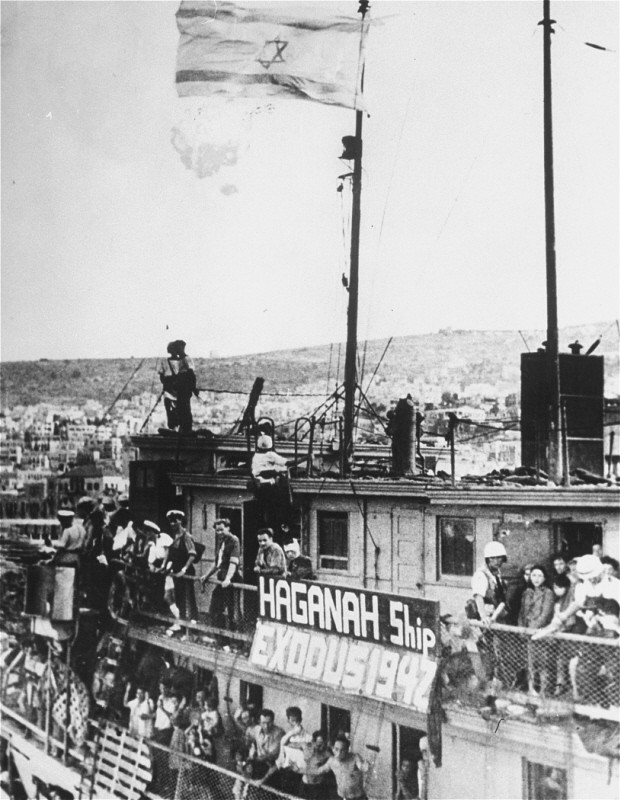 After a violent confrontation — in which several refugees were killed and many injured — British forces boarded the vessel. Rather than allow the refugees into the Mandate of Palestine, the British authorities decided to deport them back to Europe. The refugees were transported on British ships back to France where French authorities were unwilling to let them disembark. The ship then docked in Hamburg and the survivors were sent to DP camps in the British occupation zone of Germany. The fate of the Exodus passengers caused an international outcry. Images of Holocaust survivors being forcibly returned to Germany sparked widespread outrage, particularly in the United States and Europe. The British government was harshly criticized for its handling of the situation. This event drew attention to the desperate plight of Jewish survivors and to the injustice of British immigration policies.
Under increasing pressure and unable to maintain control, Britain referred the Mandate of Palestine question to the newly formed United Nations. The Exodus affair severely damaged Britain's standing on the Mandate of Palestine issue and strengthened support for the Zionist cause at the United Nations. It was one of several key factors leading to the 1947 UN Partition Plan (Resolution 181), which recommended the division of the Mandate of Palestine into separate Jewish and Arab states, with Jerusalem under international administration. The Jewish Agency, led by Ben-Gurion, accepted the plan, while Arab leaders rejected it.
On May 14, 1948, Ben-Gurion proclaimed the establishment of the State of Israel on the territory that contained a Jewish majority, as approved by the U.N. General Assembly in the partition plan. The declaration referenced the historical connection of Jews to the land and the tragedy of the Holocaust, noting:
The catastrophe which recently befell the Jewish people - the massacre of millions of Jews in Europe - was another clear demonstration of the urgency of solving the problem of its homelessness by re-establishing in Eretz-Israel (the Land of Israel) the Jewish State, which would open the gates of the homeland wide to every Jew and confer upon the Jewish people the status of a fully privileged member of the comity of nations.
Survivors of the Nazi holocaust [sic] in Europe, as well as Jews from other parts of the world, continued to migrate to Eretz-Israel, undaunted by difficulties, restrictions and dangers, and never ceased to assert their right to a life of dignity, freedom and honest toil in their national homeland.
Within hours, the United States and the Soviet Union recognized Israel. However, Arab nations rejected the new state, and the Egyptian, Syrian, Jordanian, Lebanese, and Iraqi armies launched a military invasion, beginning the 1948 Arab-Israeli War.
The Holocaust became a central element of Israeli national identity. In the early years, survivors were often marginalized; native-born Israelis (Sabras) valorized the figure of the new "Jewish fighter" over the stereotype of the "passive victim" of Europe. Over time, however, public attitudes shifted. The 1961 trial of Adolf Eichmann in Jerusalem marked a major turning point. Holocaust survivors began to publicly tell their stories, profoundly influencing Israeli culture, education, and commemoration practices.
Institutions such as Yad Vashem, Israel’s national Holocaust memorial and museum, were founded to preserve the memory of the genocide and to honor victims and rescuers. Israeli policies concerning immigration (Law of Return, 1950) allowed any Jew from anywhere in the world to gain automatic citizenship, reflecting the lesson that Jews must always have a secure homeland.
While Zionism long predated the Holocaust, the genocide of European Jewry accelerated the movement’s goals by making the need for a Jewish homeland undeniable in the eyes of many world leaders. The Holocaust provided both moral impetus and political leverage for the creation of Israel in 1948. In the years since, the memory of the Holocaust has remained a pillar of Israeli identity, influencing everything from immigration policy to military doctrine to education. Understanding this connection is crucial to appreciating both the historical context of Israel's founding and the ongoing complexities of Middle Eastern politics.


