Born Norbert Müller (see image below) on June 2, 1924 to an Orthodox Jewish family in Tann in der Rhön, Germany, Norman Miller was forced to flee his homeland alone, leaving behind his family and childhood. When the Nazi regime rose to power, new policies persecuted the Jewish population, including the forcing of Jews to live in specifically designated Jewish-only buildings. Following Kristallnacht in November 1938, during which the Müller f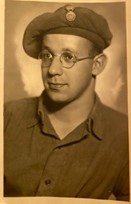 amily’s apartment was ransacked by an angry German mob, the Müllers sought to leave Germany together but were only able to secure safe passage through the Kindertransport for Norbert to Britain through the Netherlands. His parents went to great lengths to save their son. Upon learning they didn’t have the correct paperwork for the second part of Norbert’s journey, his father snuck into the closed British consulate to bribe an official to get the documentation in order. The family had registered for and optimistically planned to eventually get visas for everyone to join Norbert in Britain and then for the entire family to immigrate to the United States. However, that was not to be. At fifteen-years-old, Norbert boarded a train leaving Cologne, Germany, unaware it would be the last time he would see his family, and arrived in London alone, without any of his possessions, on August 30, 1939, just two days before the German invasion of Poland that began WWII. His family would then never be able to obtain the visas they needed to leave Germany, in part because his grandmother was given a much higher quota number, and his parents were concerned about leaving her behind.
Norbert was one of 10,000 Jewish children who were rescued from German-occupied territories by the British Kindertransport. The operation ended at the beginning of WWII, meaning he had left Germany as part of the last wave of child refugees saved by this humanitarian rescue mission. He lived in an orphanage and trained as a welder in hopes of providing for his family when they arrived. For two years, Norbert exchanged letters with his family through intermediaries in Belgium and Sweden until the communications abruptly stopped. In 1944, at age 20, Norbert anglicized his named to Norman Miller and joined the British Army, hoping that his fluency in German and assignment to an intelligence unit would enable him to learn what happened to his family.
After the war, Miller was naturalized as a British citizen but ultimately chose to emigrate from England to the United States, by way of Canada, and settle in New York where he married and had two sons. He learned from a friend who had survived the Junfernhof concentration camp in Riga, Latvia that his parents, sister, and maternal grandmother became ill with typhus and were shot to death, along with others deemed to be sick or elderly, in the forest outside of Riga and buried in a mass grave.


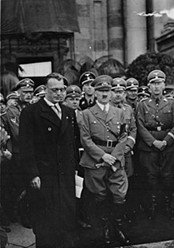 position in Poland . Only then did Norbert reveal to his sons that on May 7, 1945, he was part of the Royal Welch Fusiliers regiment, guarding a checkpoint between the American and British sectors in Hamburg when a car containing four men was forced to stop at the checkpoint. They had official papers but the Fusilier on duty wasn’t satisfied and asked Mr. Miller to help because he read German. Upon looking at the papers and recognizing Seyss-Inquart from newspapers, he understood that these were high level Nazis trying to escape capture. Only because Miller was at the right place at the right time were these Nazi officers arrested. Seyss-Inquart stood trial and was convicted by a