Skip to content
Teaching the Holocaust and other Genocides

Evian Conference Political Cartoons

Activity Overview
This activity focuses on the analysis and interpretation of political cartoons (one American and one German) related to the Evian Conference. Students should read the brief introduction to the Evian Conference before analyzing these cartoons.
Grade Level
7-12
Learning Standards for Literacy in History/Social Studies
RH1: Cite specific textual evidence to support analysis of primary and secondary sources.
RH2: Determine the central ideas or information of a primary or secondary source; provide an accurate, objective summary of the source distinct from prior knowledge or opinions.
RH7: Integrate visual information (e.g., in charts, graphs, photographs, videos, or maps) with other information in print and digital texts.
RH8: Distinguish among fact, opinion, and reasoned judgment in a text. Identify and distinguish between a primary and secondary source on the same topic.
WHST7: Draw evidence from informational texts to support analysis, reflection, and research.
Social Studies Framework
8.6 WORLD WAR II: The aggression of the Axis powers threatened United States security and led to its entry into World War II. The nature and consequences of warfare during World War II transformed the United States and the global community. The damage from total warfare and atrocities such as the Holocaust led to a call for international efforts to protect human rights and prevent future wars. 
10.5d Nationalism and ideology played a significant role in shaping the period between the world wars.
10.5e Human atrocities and mass murders occurred in this time period.
11.8. WORLD WAR II (1935 – 1945): The participation of the United States in World War II was a transformative event for the nation and its role in the world.
11.8a As situations overseas deteriorated, President Roosevelt’s leadership helped to move the nation from a policy of neutrality to a pro-Allied position and, ultimately, direct involvement in the war.

 SEL Benchmarks
1A. Identify and understand their emotions and how emotions relate to their actions. Use understanding of emotions to inform actions.
2A. Recognize and build empathy for the feelings and perspectives of others.
2B. Recognize and affirm individual identities as well as individual and group similarities and differences, including those rooted in culture, ethnicity, race, religion, sexual orientation, gender identity or expression, ability, etc.
3A: Consider individual and collective social, emotional, and physical safety and well-being, as well as social context in making decisions.
Objectives
Students will summarize the purpose and outcomes of the Evian Conference to understand the international response to the Jewish refugee crisis in 1938.
Students will analyze and interpret political cartoons—one American and one German—related to the Evian Conference, identifying symbolism, perspective, and intended message.
Students will compare and contrast the two cartoons to evaluate differing international attitudes toward Jewish refugees and reflect on how political cartoons can shape or reflect public opinion.

Essential Questions

How did the Evian Conference impact Jewish refugees?

Materials

Evian Conference Reading
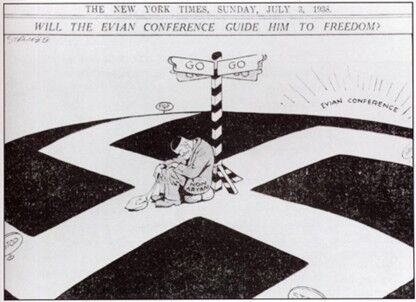
Political Cartoon: "Will the Evian Conference Guide Him to Freedom?"
Political Cartoon: "No One Wants Jews Anymore."

Activity

Introduction: Students read about the Evian Conference and answer the discussion questions.

Primary Source Analysis: Students analyze the political cartoons below and answer the discussion questions.

Conclusion: Based on the reading and the analysis of the political cartoons, students answer the essential question, "How did the Evian Conference impact Jewish refugees?"

Evian Conference Political Cartoon

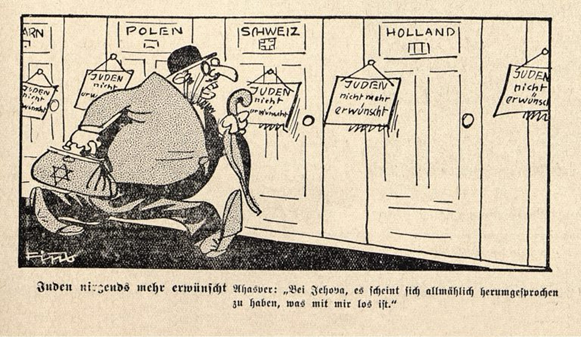
    “No One Wants Jews Anymore” Philipp Rupprecht,  (Fips)  Der Stürmer, 1938

Translations
Door signs
:
Poland, Switzerland, Holland
Sign on each door
:  Jews are no longer wanted.
Caption
No One Wants Jews Anymore.  Ahasver: "By God, word seems to
have gotten around about what's wrong with me."

Discussion Questions

1. What message does the cartoon convey about the Evian Conference’s impact on Jewish refugees?

2. How do the conflicting signs ("GO" and "STOP") symbolize the outcome of the conference?

3. Why is the refugee depicted as sitting helplessly at the crossroads?

4. How does the visual contrast between the bright "Evian Conference" and the refugee’s situation enhance the message?

5. What emotions does this cartoon evoke regarding the response of the international community to the refugee crisis?

Evian Conference Political Cartoon

      “Will the Evian Conference Guide Him to Freedom?”
        Sidney Strube, The New York Times on July 3, 1938

Discussion Questions

1. Who is the figure depicted in the cartoon, and how is he characterized?

2. What countries are listed on the doors, and what is written on the signs posted on them? What is the man in the cartoon trying to do, and what obstacles is he facing?

3. How does this cartoon reflect Nazi Germany's views and treatment of Jewish people in 1938?

4. What does this cartoon suggest about international responses to Jewish refugees fleeing persecution at that time?

5. What emotions or reactions might this cartoon have provoked among readers (Jews and non-Jews) in 1938?